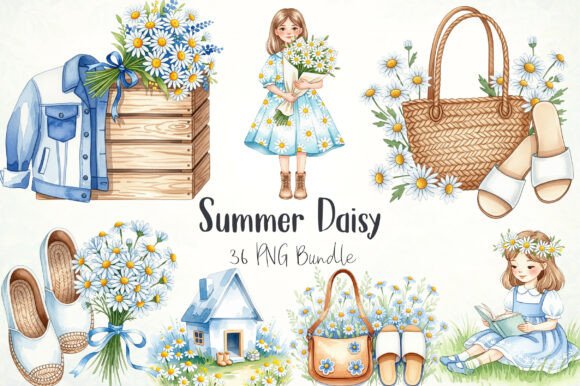
Watercolor Summer Daisy Clipart Collection: A Technical and Creative Guide for Digital Design
The intersection of traditional artistic aesthetics and modern digital fabrication has created a significant demand for high-fidelity raster graphics. Among these, the Watercolor Summer Daisy Clipart Collection stands out as a versatile asset for creators ranging from professional print-on-demand business owners to educational content developers. Understanding the technical specifications and practical applications of this specific collection is essential for maximizing output quality. Unlike vector-based graphics, this collection relies on high-resolution pixel data to convey the organic texture of watercolor media, making it uniquely suited for projects where emotional resonance and artistic softness are prioritized over infinite scalability.
Technical Specifications and Print Fidelity
When integrating digital assets into physical products, resolution is the primary determinant of success. This collection provides files at 300 DPI (dots per inch), which is the industry standard for commercial printing and high-quality home crafting. The dimensions of each file are set to 12″ x 12″, translating to 3600 × 3600 pixels. This specific pixel density ensures that when printed at full size, the daisy illustrations retain crisp edges and smooth color gradients without visible pixelation or jagged artifacts.
The choice of PNG format with a transparent background is critical for workflow efficiency. In sublimation printing and direct-to-garment (DTG) applications, transparency allows the design to sit seamlessly on colored substrates without requiring manual background removal. For professionals managing high-volume production, this pre-processed transparency reduces prepress time significantly. Furthermore, because these are raster images rather than SVGs, they preserve the complex brush strokes, paint bleeds, and paper textures inherent to genuine watercolor art. Vectorizing such organic details often results in a sterile, artificial appearance; maintaining the raster format preserves the artistic integrity that makes summer daisy designs appealing to consumers.
Understanding File Management and Delivery
Users must recognize that this is exclusively a digital product delivered in .ZIP format. No physical items are shipped, which eliminates logistics costs but places the responsibility of file management on the user. Proper extraction of ZIP files is required on both PC and Mac environments before the individual PNGs can be accessed. Additionally, users should be aware that color reproduction varies between devices. Monitors use RGB color space while printers use CMYK or specialized sublimation inks. While the 300 DPI source files are optimized for print, final output colors may shift based on printer profiles, substrate material, and heat press settings. Testing on scrap material is always recommended when color accuracy is paramount.
Applications in Apparel and Textile Design
The 36 designs included in this collection offer substantial variety for apparel creators. T-shirts remain the most common application, but the versatility of the watercolor daisy motif extends far beyond basic tees. The distressed effect styles included in the set are particularly valuable for vintage-inspired fashion lines. These textures simulate wear and age, allowing designers to create garments that feel established and comfortable rather than brand new. When applied to cotton or poly-cotton blends via sublimation or heat transfer vinyl (HTV), the soft visual texture of the watercolor complements the tactile softness of the fabric.
Tote bags and pillows represent another major category for this clipart. For tote bags, the 12-inch square format provides ample coverage for standard canvas sizes, creating a bold focal point. On throw pillows, the floral imagery aligns with seasonal home decor trends, specifically spring and summer refreshes. Because the designs feature transparent backgrounds, they can be layered over existing fabric patterns or solid colors without creating awkward white boxes around the artwork. This layering capability is essential for creating depth in textile design, allowing the daisy elements to interact naturally with the base material.
Mug Sublimation and Curved Surface Considerations
Ceramic mugs present unique challenges due to their curved surface area. The 3600 × 3600 pixel resolution provides enough data to wrap designs around standard 11oz or 15oz mugs without losing clarity. However, designers must account for distortion near the handle and rim. The watercolor style actually offers an advantage here; unlike rigid geometric logos, the organic edges of painted daisies forgive minor alignment imperfections during the pressing process. The distressed variations within the collection can also help mask potential ghosting or uneven pressure marks that sometimes occur during mug sublimation, making them a safer choice for beginners or high-speed production environments.
Educational and Professional Non-Apparel Use Cases
Beyond merchandise, high-quality floral clipart serves functional roles in education and professional communication. Educators frequently utilize botanical illustrations to enhance learning materials related to biology, seasons, or nature studies. The watercolor aesthetic is perceived as gentle and engaging, making it suitable for elementary and special education resources. Teachers can incorporate these 12″ x 12″ images into worksheets, classroom decorations, and digital presentations. The transparent PNG format allows for easy integration into slide decks and document editors without disrupting text flow or layout balance.
In professional contexts, such as event planning or small business branding, summer daisy motifs convey warmth, approachability, and seasonality. Wedding stationery designers use similar assets for invitations, place cards, and signage. The ability to resize these high-resolution files without quality loss means a single design element can serve multiple purposes within a cohesive brand identity system—from a large welcome sign to a tiny favor tag. Researchers and content creators focusing on horticulture or wellness may also find these accurate yet stylized representations useful for illustrating publications where photographic realism is unnecessary or distracting.
Digital Crafting and Mixed Media Projects
For hobbyists engaged in digital scrapbooking, card making, or planner decoration, this collection provides ready-to-use embellishments. The distinction between solid color and distressed styles allows crafters to match the clipart to their specific project theme. Solid versions work well for clean, modern layouts, while distressed options complement grunge, vintage, or shabby chic aesthetics. Since these are not SVG files, they cannot be cut with vinyl plotters in the same way vector paths can. Instead, they are intended for print-and-cut workflows or purely digital composition. Understanding this limitation prevents frustration and ensures users select the right tool for their intended technique.
Strategic Asset Utilization and Workflow Optimization
Maximizing the value of a 36-design collection requires organized asset management. Professionals should categorize files by style (solid vs. distressed) and color palette immediately after unzipping. This upfront organization streamlines the design phase, reducing time spent searching for specific variations. When resizing, always scale down from the original 3600 × 3600 pixel source rather than upscaling smaller previews. Upscaling raster images introduces interpolation artifacts that degrade print quality, whereas downscaling maintains sharpness and color saturation.
Color management remains a critical consideration across all applications. Because monitor displays emit light and printed surfaces reflect it, exact color matching is inherently challenging. Users working with sublimation should develop custom ICC profiles for their specific printer-paper-ink combination to get closer to screen accuracy. For those using the clipart in digital-only formats (social media, web design), sRGB color space is typically sufficient. However, if the same file will be used for both digital and print outputs, retaining the original high-resolution master file and exporting separate optimized versions for each medium is best practice.
Licensing, Updates, and Community Engagement
Digital design assets evolve rapidly, and staying current with trends is vital for commercial success. The creators of this collection add new designs daily, suggesting an active development pipeline. Following the store and marking favorites enables users to track emerging styles and seasonal releases. This ongoing relationship between creator and user fosters a community where feedback can influence future design directions. Supporting independent digital artists through legitimate purchases also ensures the continued availability of high-quality, niche-specific assets that generic stock libraries often lack.
Ultimately, the Watercolor Summer Daisy Clipart Collection represents more than just decorative images; it is a production-ready toolkit. Its specifications—300 DPI, transparent PNG, 12-inch canvas—are engineered for real-world manufacturing constraints. Whether producing sellable merchandise, educational resources, or personal creative projects, understanding these technical and practical dimensions transforms simple clipart into professional-grade design components. By respecting the raster nature of the files, managing color expectations, and leveraging the stylistic variety included, users can achieve results that honor both the artistic origin of watercolor painting and the precision demands of modern digital fabrication.