Yellow Chinoiserie Mother’s Day Clipart: A Practical Asset Review
The intersection of traditional aesthetics and modern print-on-demand technology has created a sustained demand for niche design assets. Among these, Yellow Chinoiserie Mother’s Day Clipart represents a specific convergence of cultural art style, seasonal relevance, and technical utility. For creators, small business owners, and DIY enthusiasts, evaluating such assets requires looking beyond the visual appeal to understand their functional value in a production workflow. This collection of 21 designs offers a distinct alternative to the ubiquitous floral or script-based graphics typically associated with maternal holidays, providing a sophisticated option for those seeking to differentiate their product lines or personal projects.
Defining the Aesthetic and Market Position
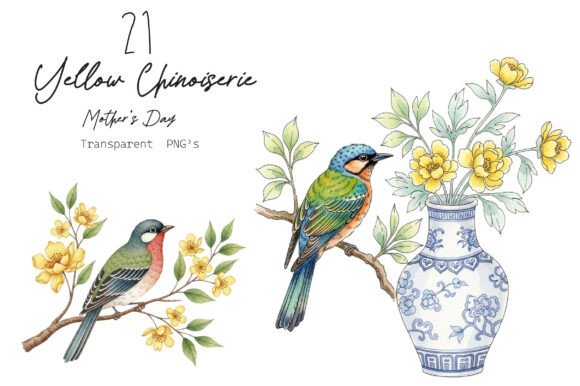
Chinoiserie is a European interpretation of Chinese and East Asian artistic traditions, characterized by intricate landscapes, pagodas, flora, fauna, and asymmetrical compositions. When adapted for Mother’s Day merchandise, this style brings a sense of heritage, elegance, and timelessness that standard vector art often lacks. The use of yellow as a primary color palette is a strategic choice; it evokes warmth, optimism, and spring renewal without relying on the saturated pinks or reds that dominate the holiday market.
For marketers and entrepreneurs, this aesthetic serves a dual purpose. It appeals to consumers looking for vintage-inspired luxury while remaining accessible enough for casual gifting. The 21 included designs provide sufficient variety to create cohesive collections rather than one-off items. Whether applied to high-end stationery or casual apparel, the style maintains a consistent narrative of refined appreciation, which can be crucial for brand storytelling during competitive seasonal peaks.
Technical Specifications and Production Quality
In digital asset procurement, resolution and format dictate usability. This Yellow Chinoiserie Mother’s Day Clipart package is delivered in PNG format with a transparent background at 300 DPI. The dimensions are fixed at 12″ x 12″ (3600 × 3600 pixels). These specifications are significant for several practical reasons:
- Print Fidelity: 300 DPI is the industry standard for commercial printing. At 12 inches square, these files are optimized for sublimation blanks like pillows, tote bags, and ceramic mugs without requiring upscaling algorithms that introduce artifacts.
- Transparency Utility: Transparent backgrounds eliminate the need for manual masking or removal tools. This streamlines the workflow for users integrating these elements into complex layouts or placing them directly onto colored substrates.
- Raster Limitations: It is critical to note that these are not SVG files. As raster images, they do not possess infinite scalability. While 3600 pixels allows for resizing down to smaller formats like stickers or tags without quality loss, enlarging them beyond 12 inches will result in pixelation. Users must plan their project dimensions accordingly.
The inclusion of both solid color and distressed effect variations adds substantial operational flexibility. Solid versions are ideal for crisp, modern reproductions on white or light backgrounds, while distressed variants offer an immediate vintage texture that saves hours of post-processing work. This duality allows a single asset pack to serve multiple demographic segments within the same product line.
Workflow Integration and Application Versatility
The practical value of any clipart set lies in how seamlessly it integrates into existing creative workflows. Because these files are delivered in a .ZIP archive, immediate organization is necessary. Professionals should unzip and categorize the files upon receipt to avoid workflow bottlenecks later. Compatibility is broad; PNGs are universally supported by Adobe Photoshop, Illustrator, Canva, Procreate, Cricut Design Space, and Silhouette Studio.
For sublimation projects, the 12″ x 12″ size aligns perfectly with standard heat press platens and common blank sizes. The yellow tones in Chinoiserie art can sometimes be tricky to reproduce due to monitor-to-printer color variance. Users should always perform test prints, as the warm yellows may shift depending on ICC profiles and substrate coating. However, the high pixel density ensures that fine details—such as brush strokes or delicate line work inherent to the Chinoiserie style—remain sharp even after heat transfer.
Beyond sublimation, these assets perform well in digital contexts. Bloggers and social media managers can utilize the distressed versions as overlays for quote cards or promotional banners, where the texture adds depth to flat digital screens. Educators and homeschoolers might find the solid versions useful for creating culturally enriching craft materials or history-themed Mother’s Day activities, bridging art education with seasonal celebration.
Evaluating Strengths and Operational Limitations
An objective assessment must weigh advantages against constraints. The primary strength of this Yellow Chinoiserie Mother’s Day Clipart is its specificity. Generic assets are abundant; curated, stylistically coherent sets are rarer. The 21-design count strikes a balance between overwhelming abundance and insufficient variety, allowing for bundle creation or tiered pricing strategies for POD sellers.
However, potential users must recognize the limitations of a digital-only product. There is no physical proof of color accuracy before purchase. The reliance on device calibration means that what appears as a soft butter-yellow on a calibrated IPS monitor might print as a vibrant gold or a muted ochre on uncoated paper. Furthermore, the absence of vector formats restricts editing capabilities. You cannot recolor individual elements within the PNG file easily; you are working with flattened layers. If your workflow requires frequent color adjustments to match specific brand guidelines, this limitation may necessitate additional editing time using hue/saturation adjustments or duotone effects.
Additionally, because this is a seasonal niche, the long-term utility depends on the timelessness of the Chinoiserie style itself. Unlike trendy memes or fad aesthetics, Chinoiserie has persisted for centuries. This suggests that unused designs retain residual value for future years or can be repurposed for general spring/home decor projects outside the Mother’s Day window, improving the return on investment.
Audience Fit and Strategic Recommendations
This asset pack is not universally applicable, but it is highly valuable for specific user profiles. Small business owners operating in the home decor, stationery, or boutique apparel spaces will find the highest ROI. The aesthetic aligns with customers who value craftsmanship and cultural fusion over mass-produced sentimentality. Freelance designers working on custom commissions for clients seeking "something different" will appreciate having a ready-made, high-quality resource that reduces billable design hours.
For serious hobbyists and DIY crafters, the distressed options lower the barrier to entry for achieving professional-looking vintage results. Conversely, corporate marketers or brands with strict minimalist guidelines may find the ornate nature of Chinoiserie too busy for their identity. It is essential to evaluate whether this intricate style complements or conflicts with your existing visual language before acquisition.
When utilizing these designs, consider pairing them with complementary typography. Serif fonts or elegant scripts tend to harmonize better with Chinoiserie motifs than bold sans-serifs. Also, leverage the negative space within the 12″ x 12″ canvas; the artwork likely does not fill every pixel, providing natural areas for text placement without obscuring the design.
Maintaining Creative Momentum
Acquiring assets is only one step in a sustainable creative practice. The provider notes that new designs are added daily, suggesting an active development pipeline. For professionals and entrepreneurs, following the store and curating favorites can serve as a trend-watching mechanism. Observing which styles receive updates or expansions provides insight into market movements and consumer preferences.
Ultimately, Yellow Chinoiserie Mother’s Day Clipart functions as more than just decorative imagery; it is a production-ready tool designed for specific technical and aesthetic outcomes. Its value is realized when matched with appropriate projects, proper color management, and realistic expectations regarding raster limitations. By understanding both the artistic heritage and the digital specifications, users can effectively leverage this collection to create meaningful, high-quality work that stands out in a crowded seasonal marketplace. Supporting independent digital artists through informed purchasing also contributes to the broader ecosystem of unique, non-generic design resources available to the creative community.